Smarter training starts here. Athletica’s newsletters deliver science-backed insights, expert tips, and AI-powered training updates for endurance athletes of all levels. Catch up on past editions and subscribe to stay ahead in your training journey.
Sports Science 3.0: From Knowing More to Choosing Better
|
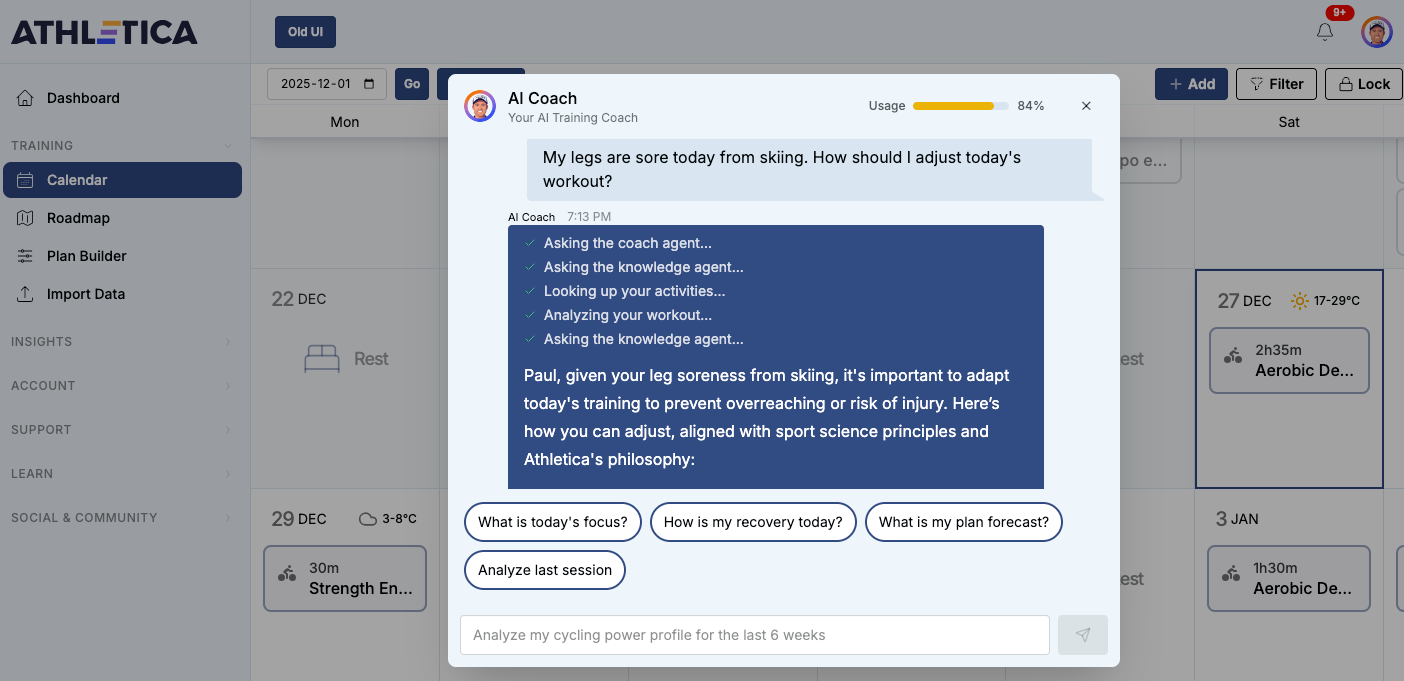
Hello Reader, As our team at Athletica puts the final pieces in place for the launch of our new platform, including the new UIX, conversational AI-Coach, and Athletica U, I wanted to pause and share a broader perspective. There is a lot of noise right now around “AI coaching.” Much of it is well intentioned, but some of it risks distracting from the real work that matters: helping athletes and coaches make better decisions day to day. The piece below is longer than a typical email, but it sits at the core of what we are building at Athletica. It outlines how sport science has evolved, and why the next step is not more data or smarter predictions, but better coaching choices grounded in physiology, training theory, and context. This is what we mean by Sports Science 3.0. This will be my last long-form note here for a little while, as we shift focus to letting our team properly walk you through what’s coming with the platform launch in the new year. I hope you enjoy the read. Paul Why the next era of coaching won’t be defined by data, dashboards, or AI hype, but by better decisions.The rise of the “AI coach”We are entering a phase in sport where nearly every platform will describe itself as an “AI coach.” The promise is seductive: sync your data, trust the system, and let the algorithm decide what you should do next. On the surface, this sounds like progress. But beneath it sits a quiet assumption that deserves scrutiny: that better predictions automatically lead to better decisions. They don’t. Prediction is not the same as decision-makingFor most of coaching history, the hard part was not knowing what could happen. It was deciding what should happen next. For a particular athlete, in this moment, with this history. That problem has not gone away. It has simply been hidden under more computation. Coaching has always been a judgment problemAI is exceptionally good at pattern recognition. It is far less equipped to understand context, purpose, and consequence without constraint. Left unconstrained, intelligent systems will always optimize for confidence and continuity. Training, however, demands restraint. Sometimes the right decision is not the most obvious one. From automated prescription to decision supportThis is why I believe the future of coaching is not automated prescription. It is decision support grounded in physiology, training theory, and human judgment. Expert-designed structure is not a relic of the past. AI should not replace that structure.
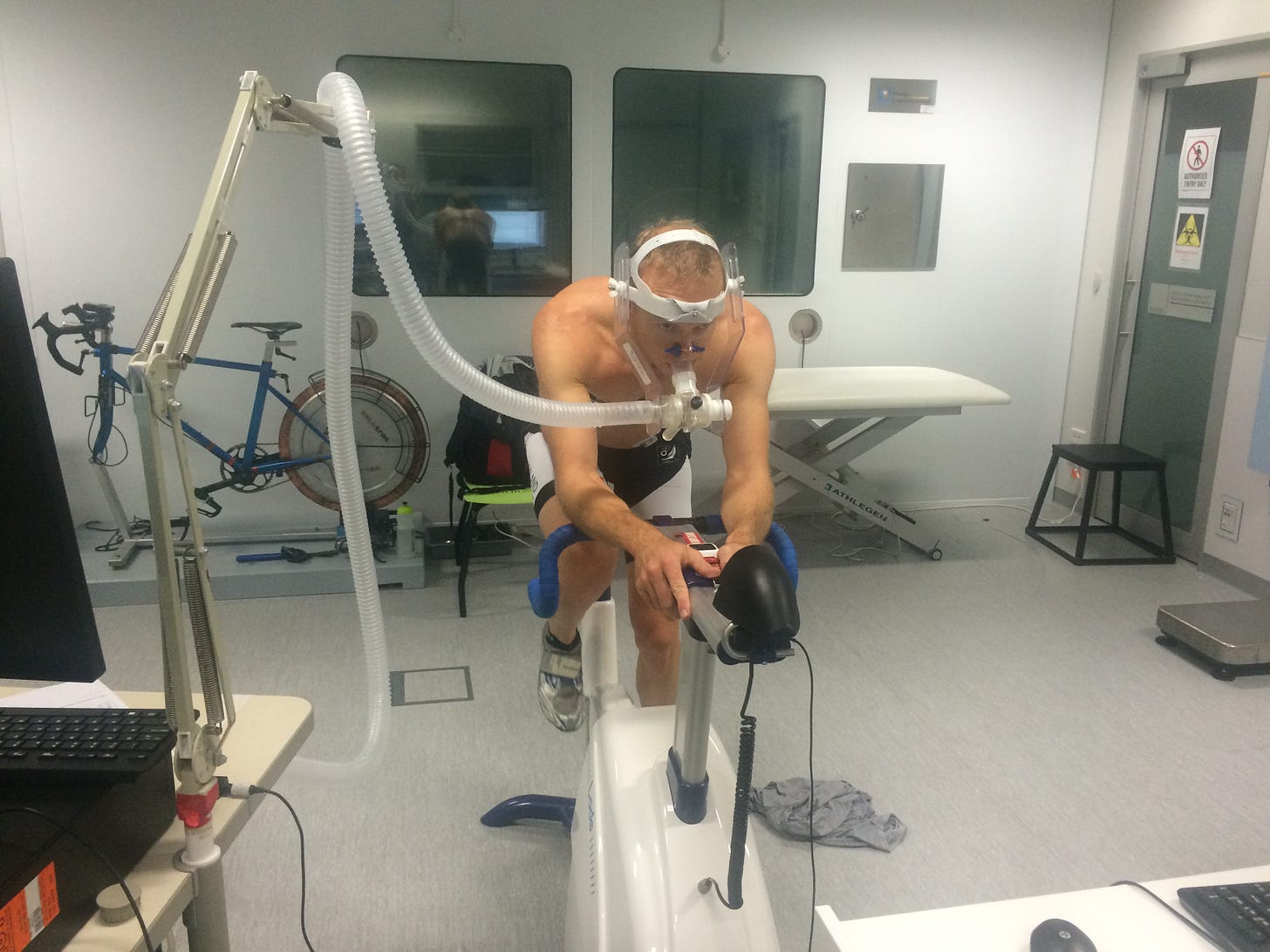
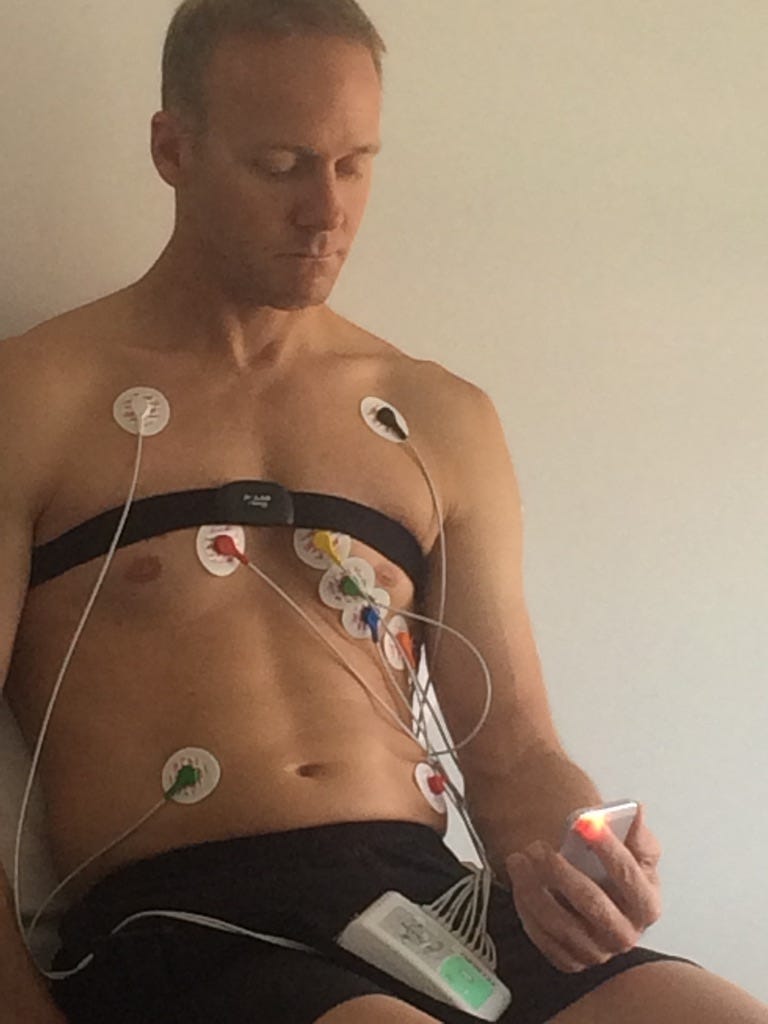
When progress meant measuring moreFor most of my career in sport science (above photo), progress was easy to define. We measured more. Physiology moved out of the lab.
And yet, despite all of this, the most common question I still hear from coaches and athletes is unchanged: "What should I do today?" The Limits of Measuring MoreSports Science 2.0 gave us powerful tools.
But tools alone don’t make decisions. In practice, more data often led to:
The issue was never data availability. Decision-making under uncertaintyCoaching is not about knowing everything. When to push. Those decisions are shaped by physiology, but also by:
Sports Science 2.0 described these factors.
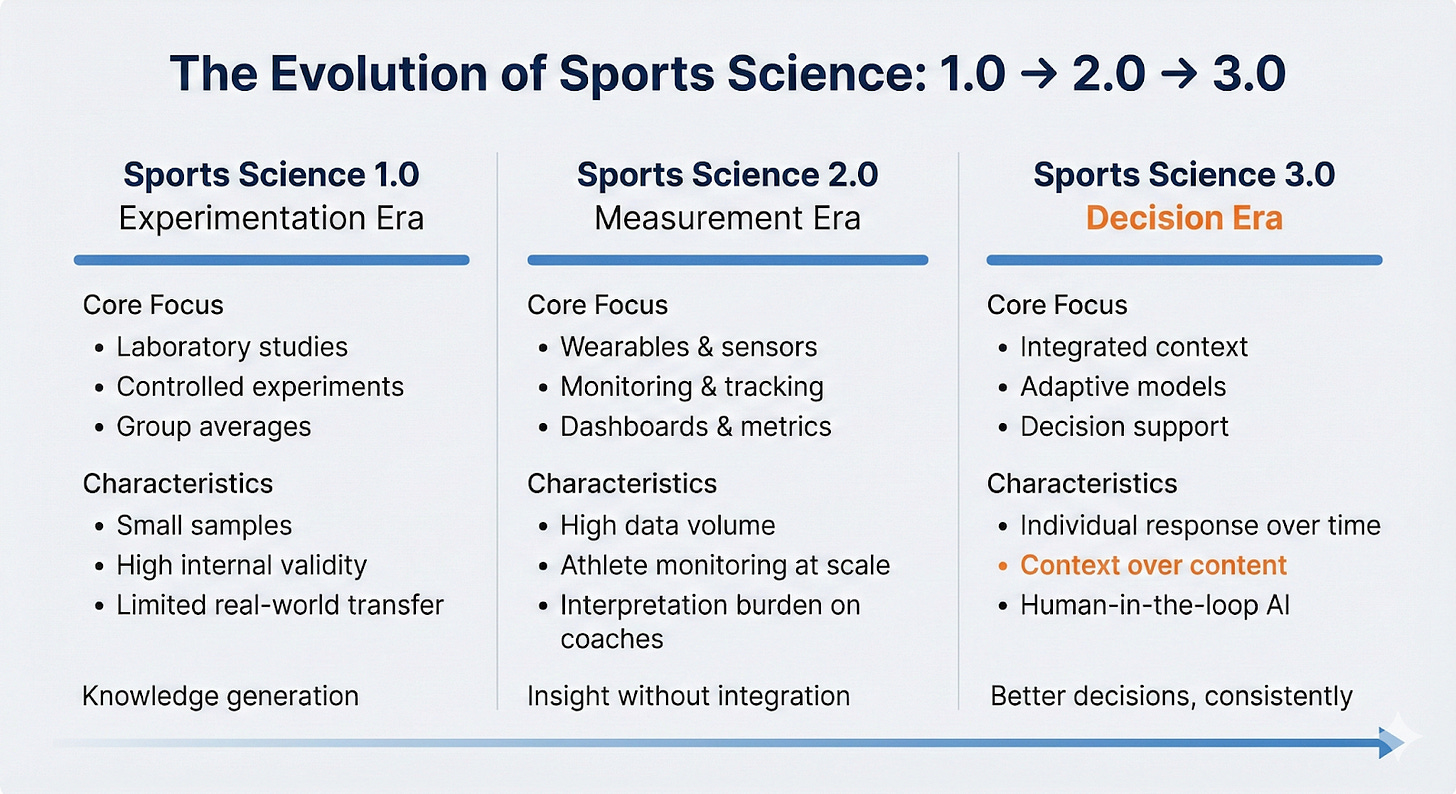
Sports Science 1.0 vs 2.0 vs 3.0Sports Science 1.0 focused on experimentation in controlled settings, building foundational physiological principles through laboratory research and group averages. Sports Science 2.0 shifted science into the field, emphasizing measurement through wearables, sensors, and dashboards, dramatically increasing data availability but often leaving interpretation to coaches. Sports Science 3.0 focuses on decision support, integrating physiology, training theory, athlete context, and observed load–response to help coaches and athletes choose better actions day to day. This progression captures the arc of sport science over the past three decades. What We Mean by Sports Science 3.0Sports Science 3.0 is partly a technology upgrade. But equally, it is a philosophical shift. From:
At its core, Sports Science 3.0 asks one question: How do we leverage foundational principles with sensor technology and AI to help coaches and athletes make better day-to-day training decisions? Context Over Content (Now Made Operational)For years, coaches have said, “It depends.” That was never a weakness. What’s changed is that context no longer has to live only in the coach’s head. With longitudinal data, athlete feedback, and computational models, we can now:
Context doesn’t disappear.
What AI Means in Sports Science 3.0Here, AI does not mean automated prescription or systems that decide training in isolation. It refers to decision support systems that are constrained by physiology, training theory, and human judgment. These systems integrate data, context, and expert structure to inform decisions, not replace the coach or athlete responsible for making them. Where AI Fits (and Where It Doesn’t)AI is not the coach. AI is coaching infrastructure. Its role is to:
Great coaches don’t disappear in Sports Science 3.0. The Athlete Is Not a DatasetAthletes are not passive data generators. Their comments, perceptions, effort, and confidence are not noise. Sports Science 3.0 treats athletes as active participants in the system (see below), not objects being monitored. When athletes understand why a decision is made, trust follows.
Why This Matters NowWe are entering an era where everyone will claim to have an “AI coach.” Many will be built on:
The real differentiator will not be artificial intelligence alone. It will be judgment, informed by expert-designed training structure and systems, athlete context, and observed load–response over time. A Living ExampleThese ideas aren’t theoretical. In our recent year-end conversation, Sports Science 3.0: The Next Chapter, Martin Buchheit and I reflected on how this shift is already unfolding, in rehab environments, endurance sport, team sport monitoring, and AI-supported coaching systems. We discussed:
If you want to hear these ideas evolve in real time, that conversation is available here. A Closing ThoughtIf Sports Science 1.0 was about experimentation, knowledge generation, and foundational principles, and Sports Science 2.0 was about measurement in the field, then Sports Science 3.0 is about choosing better. Better for performance. Better for health. Better for longevity. Those choices should be evidence-informed, efficiently delivered, and grounded in a rationale that is fully explainable. That is the shift. That is the work ahead. We are grateful for the support of our Athletica community, whose members are active participants in this journey with us. |

Athletica AI Coach and Training Science
Smarter training starts here. Athletica’s newsletters deliver science-backed insights, expert tips, and AI-powered training updates for endurance athletes of all levels. Catch up on past editions and subscribe to stay ahead in your training journey.

Hello Reader, Sebastian Sawe ran 1:59:30 in London last weekend. Three men finished under the previous world record for the marathon. Coaches and media publicly credited 100–120 g/hr of carbohydrate. The running internet promptly lost its mind. So on the Athlete’s Compass Podcast this week, Paul Warloski and I took the question head-on: should you be eating like Sawe? Short answer: no. But the longer answer is more interesting. And it points somewhere the sports nutrition field hasn’t quite...
Welcome to Inside Athletica April edition. The Workout Wizard is now live for everyone - including inside the mobile app. Smarter swaps, better context, and more flexibility when life doesn’t go to plan. We’re also actively working on upgrading the AI Coach. The feedback you’ve been sending has been incredibly valuable - keep it coming. With summer around the corner, many of you are heading into marathon blocks. This is where consistency, smart adjustments, and staying healthy really start to...
Welcome to Inside Athletica Most athletes try the Athletica AI Coach once, get a vague answer to a vague question, and move on. This month’s Inside Athletica is a simple fix: how to ask better questions so you get specific, data-driven answers based on your training history. Start with the quick guide (“What can I ask?”), then go deeper with the blog + podcast(s). You’ll leave with questions you can copy/paste for training decisions and for customer-service type issues inside Athletica. Good...