Smarter training starts here. Athletica’s newsletters deliver science-backed insights, expert tips, and AI-powered training updates for endurance athletes of all levels. Catch up on past editions and subscribe to stay ahead in your training journey.
The Two-Pool Problem
|
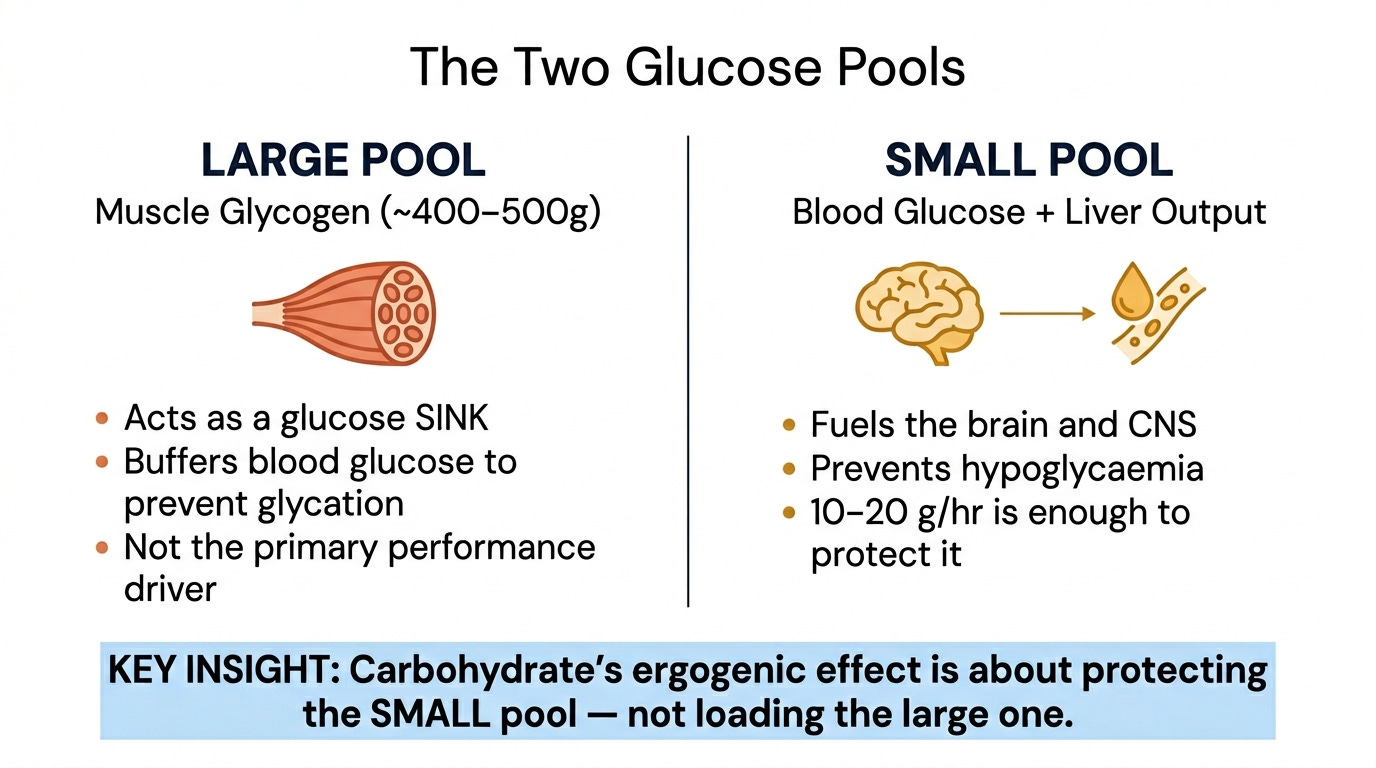
Hello Reader, Sebastian Sawe ran 1:59:30 in London last weekend. Three men finished under the previous world record for the marathon. Coaches and media publicly credited 100–120 g/hr of carbohydrate. The running internet promptly lost its mind. So on the Athlete’s Compass Podcast this week, Paul Warloski and I took the question head-on: should you be eating like Sawe? Short answer: no. But the longer answer is more interesting. And it points somewhere the sports nutrition field hasn’t quite arrived yet. This post is the companion piece — the figures and reading list I promised on air, plus a little more depth on the potential mechanisms. The two-pool model — a quick primer Here’s the framework that Tim Noakes and colleagues lay out in their Endocrine Reviews paper, and the one I think is closest to what the data actually supports.
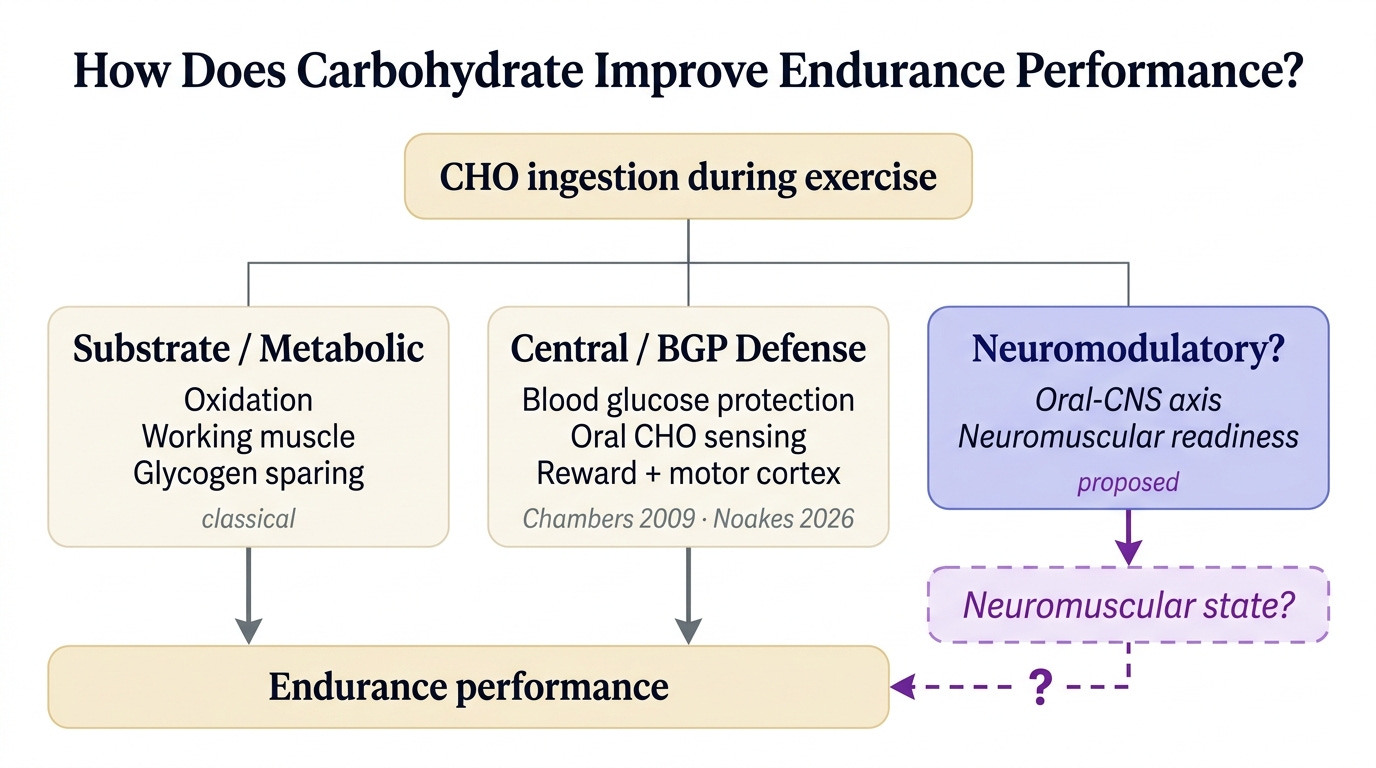
What this means practically: you need enough carbohydrate when you perform to prevent hypoglycaemia. That’s it. The dose required to do that is far lower than what elites are taking. Phil Prins’s group showed this directly. Six weeks on a high-fat diet, six weeks on high-carb, same well-trained triathletes. In both conditions, all it took was 10 g/hr to preserve performance versus placebo. Ten. The study won AJP’s paper of the year. It’s worth your time (reference below). The classical model said this: take more carbs, spare more glycogen, go longer. It made intuitive sense. But it appears to be mostly wrong. And at elite doses, it may actually reverse. Andy King’s group tested this directly, twice. In the 2018 study, ten trained cyclists rode at 77% VO₂max across five carbohydrate conditions ranging from 60 to 112.5 g/hr, with stable isotope tracers tracking exactly where fuel was coming from. Pushing the dose beyond intestinal transporter saturation — into the territory elites actually use — significantly increased muscle glycogen utilization, not reduced it (effect size = 1.68, p = 0.014). The 2019 follow-up ran the same logic over three hours: 100 g/hr burned more muscle glycogen than 90 g/hr. The authors’ own conclusion: “overdosing intestinal transport appears to increase muscle glycogen reliance.” So at the doses being credited with world records, you’re not sparing glycogen. You’re burning more of it. Now let's think about why. When you flood the blood with glucose, the body has to do something with it. The muscle glycogen pool may be acting as a glucose buffer — pulling excess glucose out of circulation to protect against its toxic effects. Advanced glycation end-products (AGEs) are what happen when glucose chronically melds into your proteins. That’s accelerated ageing. Your body doesn’t want that. There’s a real case that muscles are acting as a glucose sink first, and an energy source second. So what IS high-dose carbohydrate doing? Here’s the puzzle. If elite athletes are taking 100–120 g/hr, and increased CHO oxidation (fuel burning) doesn’t explain the performance boost, what’s going on? Jeukendrup’s mouth-rinse studies point to the most interesting direction. Athletes who rinsed carbohydrate solution — and spat it out — showed improved performance versus placebo, with no substrate entering the body at all. Chemoreceptors in the mouth activate reward circuits in the brain. The brain reads ‘energy incoming’ and releases the brake on effort. With frequent small concentrated doses every 10–15 minutes that athletes are doing, that signalling pathway likely stays active throughout a race. Therefore it might not be about fuel delivery, but more about continuous CNS reassurance. A 2:05 marathoner, when asked what he felt when the sugar repeatedly hit said: ‘something was unlocked.’ That’s not a metabolic description. That’s a pharmacological one. Figure 2 maps where the science currently sits — and where it doesn’t. The first two pathways are established, if contested. The third is where we need to go. There may be a mechanism connecting what the brain is doing via the oral-CNS axis to something measurable in the muscle itself — a pathway that runs in parallel to substrate and BGP defense, and that may explain a meaningful chunk of what elite athletes are actually experiencing when the carbs hit. We’re not ready to go public with the full hypothesis yet. But the figure shows you the shape of the gap we’re trying to fill. Watch the “Neuromuscular state?” box.
What you should actually do For age-groupers and masters athletes — the Athlete's Compass audience — the evidence is pretty clear: PRACTICAL CARBOHYDRATE TARGETS BY DURATION
Gut training required? Probably — whatever you’ll use on race day, practise in long training sessions. GI incidents at high doses are common and they don’t disappear without specific gut conditioning. Note: 100+ g/hr may require months of gut adaptation. The risk of GI distress at that dose for untrained guts is real and well documented.
The broader point: every article pinning Sawe's 1:59:30 on the carbs is underselling the 20 years of training, the coaching, the genetics, the cultural pressure to perform. The shoes and the gels are the last 1%. Irrespective of the fuelling debate, it's the consistent, smart training you accumulate over months and years — not any fuelling concoction or quantity thereof — that drives performance on race day. Full references via this link. Yours in training, Paul Laursen, PhD |

Athletica AI Coach and Training Science
Smarter training starts here. Athletica’s newsletters deliver science-backed insights, expert tips, and AI-powered training updates for endurance athletes of all levels. Catch up on past editions and subscribe to stay ahead in your training journey.
Hello June has felt like a month where everything we talk about came to life. Iris Nafshi, a researcher who studied moms training for Ironman while raising kids and finishing a PhD. A virtual 5K that pulled in athletes from all corners of the globe on the same weekend. A blog MJ wrote a couple years ago about why "balance" is a myth, and why MJ still stands by every word. Three different things. Same idea underneath: big goals are possible in a full life. They just require a different kind of...

Dear Reader, I remember learning about energy systems in school. Professor Paul Gastin's diagram was the gold standard: a clean picture of how much each system contributed depending on effort duration. You've probably seen similar. ATP-PCr, Glycolysis/lactic, Aerobic; each with its lane, each with its moment. Gastin (2001)'s classic energy system interaction model for maximal exercise. Then I watched a film that added the piece Gastin hadn't for me. That these systems are never one or the...
Welcome to Inside Athletica April edition. The Workout Wizard is now live for everyone - including inside the mobile app. Smarter swaps, better context, and more flexibility when life doesn’t go to plan. We’re also actively working on upgrading the AI Coach. The feedback you’ve been sending has been incredibly valuable - keep it coming. With summer around the corner, many of you are heading into marathon blocks. This is where consistency, smart adjustments, and staying healthy really start to...